
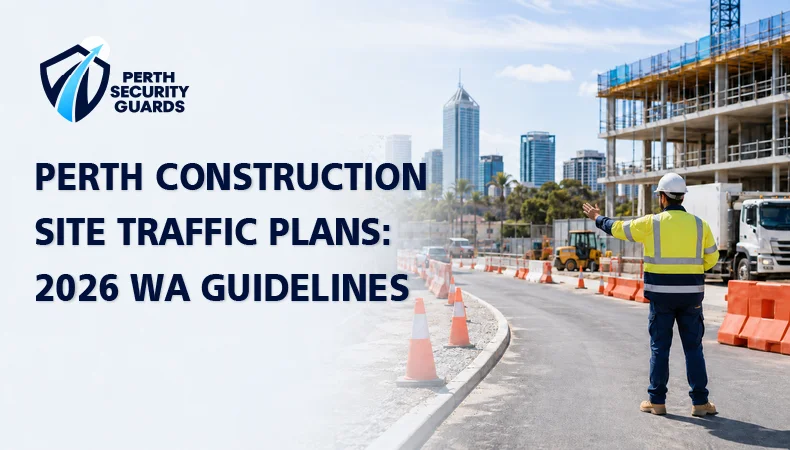
Perth Construction Site Traffic Plans: 2026 WA Guidelines
August, 18 2026Every Perth construction site with vehicles, pedestrians, or public road access needs a Traffic Management Plan (TMP), and in 2026, the rules around them are tighter than ever. Whether you're managing a small residential build or a major civil project, getting your TMP right is not about ticking the compliance box. It's about keeping your site visitors, crew, and the public safe while avoiding costly delays, fines, stop-work orders, and awkward calls with your client explaining why the crane hasn't moved. Here's what Perth builders and developers need before their next project starts.
What is a Traffic Management Plan (TMP)
A traffic management plan is a formal, site-specific document that exactly defines how traffic — including vehicles, workers, drivers, pedestrians, and your own crew — will be managed while construction work changes the normal conditions of the road. This advanced worksite traffic plan is designed based on detailed traffic analysis to protect workers, motorists, and the public from avoidable risks, confusion, and potential collisions, while meeting the requirements of Main Roads Western Australia.
A site-specific traffic control plan helps with:
- Motor vehicle movements
- Footpath closures
- Worksite access points
- Construction vehicle entry and exit
- Freeway lane management
- Changes to normal conditions
- Cyclist movements
- Traffic signal arrangements
- Temporary road occupancy
- Temporary road closures
- Pedestrian access
- Temporary speed restrictions
- Warning and regulatory signs
- Deliveries and heavy vehicles
- Emergency vehicle access
- Parking restrictions
- Lane closures
- Traffic controller Perth
Perth's construction industry has genuine reasons to take this traffic planning seriously. Main Roads WA data shows that over 70% of serious road accidents are caused by driver behaviour rather than risky road conditions, and Safe Work Australia figures identify vehicle collisions as the leading cause of workplace fatality on construction sites in 2025. A TMP is not just a ticking-the-box exercise — it's an effective traffic control method, reducing conflicts between vehicles and pedestrians and maintaining site safety around the construction road.
Why Construction Needs Site-Specific Traffic Management Plans
- Different site risks: Every construction site has its own road layout, traffic flow, and surrounding conditions.
- Busy Perth roads: Construction often takes place near high-traffic roads, residential streets, and commercial areas.
- Worker protection: Site-specific traffic management planning helps protect workers operating near moving traffic.
- Safer vehicle movements: Proper planning reduces conflicts involving trucks, machinery, and other vehicles.
- Pedestrian safety: It keeps pedestrian routes clear and safely managed around active work zones.
- Cyclist safety: Traffic management plans can account for cyclists using or passing the work area.
- Changing conditions: Significant traffic changes can be made as the construction stage progresses.
- Emergency access: Compliant site planning helps maintain suitable access for emergency vehicles.
- Clear traffic guidance: Appropriate temporary traffic signals, signs, and controls help road users understand changing conditions.
What Counts as "Near a Road" (More Than You'd Think)
A lot of construction builders assume a TMP only kicks in for major roadworks — lane closures, big civil jobs, that sort of thing. In reality, the requirement applies to a much wider range of construction activities. If your site work touches a road reserve — including verges, footpaths or nature strips — you're in TMP territory.
Practically, that means:
- Digging footings within a metre or two of the kerb
- Setting up a crane that swings over a footpath
- Running a delivery truck onto a verge, even briefly
- Installing temporary barriers around an active worksite
- Parking a concrete pump or truck partly on the road while pouring
- Storing materials, skip bins, or site sheds on the verge or nature strip
- Digging a trench for services (power, water, NBN) that crosses under a footpath
- Using a mobile crane or EWP positioned on or near the carriageway
- Reversing trucks or plant across a footpath or shared path
- Erecting temporary fencing that reduces footpath width
- Any site access point where vehicles cross a public footpath to enter or exit
- Any work that could affect how pedestrians, cyclists, or drivers move past the site
Main Roads WA and local councils apply these requirements broadly on purpose: a small suburban job with an unmanaged truck movement can be just as dangerous as a full lane closure. If your Perth site boundary sits anywhere near public road infrastructure, assume you need a plan until proven otherwise.
Who Can Actually Write Your TMP?
This is where many construction builders get caught. You can't just have your site supervisor sketch up a plan and submit it. Every TMP must be prepared and submitted by someone holding a current Advanced Worksite Traffic Management (AWTM) accreditation; without it, the plan is invalid. For complex excavation projects, the bar sits even higher.
All traffic management plans involving complex traffic management arrangements must be reviewed and endorsed by Roadworks Traffic Managers (RTMs), the highest accreditation available in the WA traffic management industry. A person holding Worksite Traffic Management (WTM) accreditation can make on-site modifications but can't design the complete traffic control plan from scratch.
If your project is near a signalised intersection, the accreditation requirement gets stricter again. Works within 30 metres of a signalised intersection need a site-specific TMP, and works that directly affect signal operation or close a lane within the intersection may require RTM endorsement and notification to the Main Roads Traffic Operations Centre.
Practically, it means the accreditation of whoever you're engaging for your traffic management service should be the first thing you check — not something you find out only after your application is rejected.
What Changed in the 2026 Code of Practice
- AGTTM Part 8 (Edition 2) adopted: The revised Code now references the updated Austroads guidance.
- Site visit before finalising a TMP: The site must be inspected before the TMP is finalised to confirm the plan reflects actual conditions.
- More consultation required: Public Transportation Coordination Division consultation requirements have been updated.
- Real site conditions matter: A TMP cannot simply be prepared from drawings or photos; the site conditions need to be checked thoroughly.
- Path closure guidance: Main Roads WA has provided clearer guidance for managing path closures.
- Clearer traffic management plans: The Code provides clearer references to Individual Management Plans and Complex Traffic Management Plans.
- Updated sign tolerances: Requirements around temporary traffic signs have been tightened.
- Industry input: The revised Code was developed with input from organisations across on-site traffic management, construction, engineering, and local government.
Complex vs Basic Traffic Management Plans: How They Can Affect Your Timeline
| Factor | Basic/Low Complexity Traffic Plan | Complex Traffic Management Plan |
|---|---|---|
| Typical Work | Short-term works with limited impact on road users | Higher-risk or higher-impact works requiring more detailed traffic arrangements |
| Traffic Impact | Minor changes to normal traffic conditions | Significant changes to traffic flow, capacity, or road-user movements |
| Lane Arrangements | Limited or straightforward lane management | Major lane closures, diversions, contraflow, or complex traffic staging |
| Road Type | Generally lower-speed or lower-volume roads | May involve freeways, high-speed roads, multilane roads, or high-volume routes |
| Traffic Signals | No significant changes to signal operation | Changes to signal function, displays, phasing, or lane closures near signalised intersections |
| Risk Level | Lower residual risk after assessment | High residual risk or arrangements requiring additional risk controls |
| Road Safety Barriers | Standard traffic-control devices may be sufficient | Temporary road safety barriers can make the arrangement complex |
| Traffic Staging | Often relatively straightforward | May require multiple construction stages and changes to traffic controls |
| Specialists Review | Does not normally require complex-arrangement RTM endorsement | Complex TMP plans may need review and endorsement by an accredited RTM |
| Documentation | Generally simpler traffic management documentation | More detailed plans, risk assessment, staging, and supporting information may be required |
| Stakeholder Coordination | Usually fewer coordination requirements | May require coordination with Main Roads WA, local government, public transport authorities, utilities, or other stakeholders |
| Approval Timeline | Often shorter, but depends on the relevant road authority | Usually needs more lead time because of additional review, coordination, and approval requirements |
| Example Perth Timeline | Some local authorities recommend around 10 business days for low-complexity works | Some Perth-area authorities recommend around 20 business days for complex works, excluding additional notification periods |
| Road Closures | Minor or limited restrictions may remain relatively simple | Full or significant road closures can require additional planning, notification, and approval time |
| Effect on your Project | Easier to accommodate within a short construction schedule | Should be planned well ahead because review, endorsement, stakeholder coordination, and approval can extend the pre-start period |
What Should a Traffic Management Plan Include
Site Information
- Worksite location, road type, work area, and construction activities.
- Existing road conditions, nearby intersections, access points, and surrounding land use.
Traffic Conditions
- Existing traffic volumes, vehicle movements, speed limits, and peak traffic conditions.
- Expected changes to traffic flow caused by construction activities.
Pedestrian Management
- Safe pedestrian routes around the worksite.
- Footpath closures, crossings, barriers, and alternative access where required.
Construction Vehicle Access
- Construction vehicle access and movement around the construction area.
- Safe vehicle routes and arrangements to minimise conflicts with road users.
Traffic Control Devices
- Signs, barriers, cones, delineation devices, speed controllers, and other measures should be selected and positioned in accordance with the Manual of Uniform Traffic Control Devices (MUTCD) and applicable WA requirements.
- The placement and use of each device should be based on the site's actual conditions.
Perth Traffic Controllers
- Traffic controllers may be required to direct vehicles and pedestrians through affected areas.
- Their locations, responsibilities, communication methods, and required traffic control arrangements should be clearly identified — see our traffic management services for how this is handled on active sites.
Worksite Layout
- The location of work areas, traffic lanes, pedestrian routes, vehicle access points, barriers, and traffic control devices.
- A clear road layout helps workers and road users understand how traffic will move around the construction site.
Traffic Management Company Accreditation: Not Just the Individual
It's not enough for the person drafting your traffic management plan to be accredited; the company offering traffic management professionals should be registered too. Under City of Perth policy, all companies engaged in professional traffic management on City roads must hold current registration in the State Road Traffic Management Company Registration Scheme administered by Main Roads WA.
- Companies need current third-party certified safety and quality systems, not just accredited staff.
- Applies to contractors, local governments, and utility providers working on State roads.
- Businesses hold registration typically for three years, with no transfer between permitted companies.
- Labour hire and subcontracted traffic management work aren't permitted under the scheme.
- Registered companies are subject to Main Roads audits, including staff accreditation checks.
Always verify a contractor's registration before engaging them — using an unregistered company can jeopardise your TMP approval.
When Triggers the Requirement (Even When You Don't Expect It)
Perth builders sometimes assume that a TMP is only needed for major road closures or big civil projects. In practice, the trigger is much broader. Any work affecting a public road, footpath, or shared space may require traffic management. This includes roadworks, utility works, construction, events, footpath activities, parking impacts, and oversize vehicle movements. Even smaller jobs — such as crane lifts, light-pole installation, or footpath excavation — may require an appropriate TMP.
Work within a Main Roads WA road reserve, including lane closures, pole installation, excavation, or crane lifts, may require a TMP endorsed by an accredited Roadworks Traffic Manager (RTM). Greater Perth councils also apply relevant traffic management requirements. If your scope of work involves high-risk construction activity near a road, you'll also need a Safe Work Method Statement (SWMS) that identifies hazards and documents control measures, working alongside your construction site security and TMP rather than replacing them.
How to Build a TMP that Actually Works in 2026
A compliant TMP is not just a document that gets you past approvals — it's a highly effective plan built to protect your crew, site visitors, and the public moving around the construction site.
Key points to consider:
- Start with a construction site visit. Main Roads now requires confirmation that a site visit was carried out before the effective plan is finalised.
- Use the correct Main Roads TMP template and complete every section — even the ones that don't apply, just mark them N/A.
- Match the TMP plan to the job. Small stuff can use a simple TMP, but lane closures or anything near traffic lights needs a sign-off from an accredited RTM.
- Double-check accreditations are current before you submit; an expired ticket is one of the easiest ways to get bounced back.
- Give people a heads-up early, especially Transperth if buses are affected (they want 5 business days' notice).
- Big multi-stage job? Use one overarching plan for the whole project instead of smaller plans for each stage.
- Spell out who to call if something happens on-site, or if you need any changes in the TMP plan that get approved without blowing your residual risk.
Frequently Asked Questions
Do all construction projects need Traffic Management Plans?
No, a TMP is generally required when the construction project affects traffic, road access, pedestrians, cyclists, or the public road reserve.
How long does traffic management plan approval take in Perth?
It depends on the project and approving authority. Basic plans may take several days, but complex TMPs require more time for consultation and review.
What happens if construction conditions change?
The TMP should be reviewed and updated if site conditions, pedestrian access, road access, or work activities change significantly.
Do residential builds need TMPs?
Not always. A residential construction project may need a TMP if it blocks a footpath, occupies the road reserve, affects road traffic, or involves construction vehicles accessing the roads.
Does a traffic management company need registration?
Where applicable, yes. Companies providing professional traffic management on City of Perth roads must meet the relevant Main Roads WA registration requirements.
The Bottom Line!
Do not assume a TMP is only for major roadworks. The TMP requirements for construction sites are not simpler in 2026. The current Main Roads WA Code applies broadly to work within road reserves and situations where construction activities interfere with normal road use.
Before starting any project, the builder should confirm:
- Whether traffic management is required.
- Whether RTM endorsement is necessary.
- What type of approvals are required.
- Whether pedestrians are affected.
- How construction vehicles will leave and enter.
- Whether nearby intersections or signals are affected.
Any residential construction site with a blocked footpath, a commercial project with frequent truck movements, or a crane operation beside a busy Perth road can all create traffic management problems. That's why it's better to identify all the risks and pair your traffic plan with proper construction site security to create an effective Traffic Management Plan, which helps reduce unnecessary traffic management issues.
Pro Tip: The right TMP becomes a smooth part of your approval process rather than the thing holding up your start date.